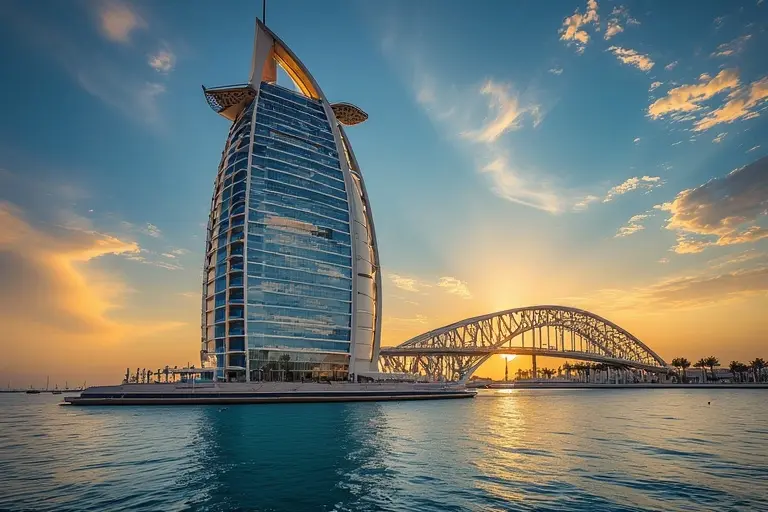
You see it in every picture of Dubai. It’s the famous “sail” standing proud in the blue Arabian Gulf.
This building is the Burj Al Arab. Many people call it the world’s only “7-star hotel.”
As a travel expert in Dubai, I’ve seen this icon thousands of times. But the real magic is in the architecture and story behind Dubai’s iconic 7-star hotel. It’s more than just a hotel. It’s a story of ambition, engineering, and pure imagination.
Let’s dive into how this building came to be.
The Dream: An Icon for Dubai
The story starts in the early 1990s. Dubai’s leader, Sheikh Mohammed bin Rashid Al Maktoum, had a bold vision.
He wanted to put Dubai on the world map. He didn’t just want another hotel; he wanted a building that would do for Dubai what the Eiffel Tower did for Paris.
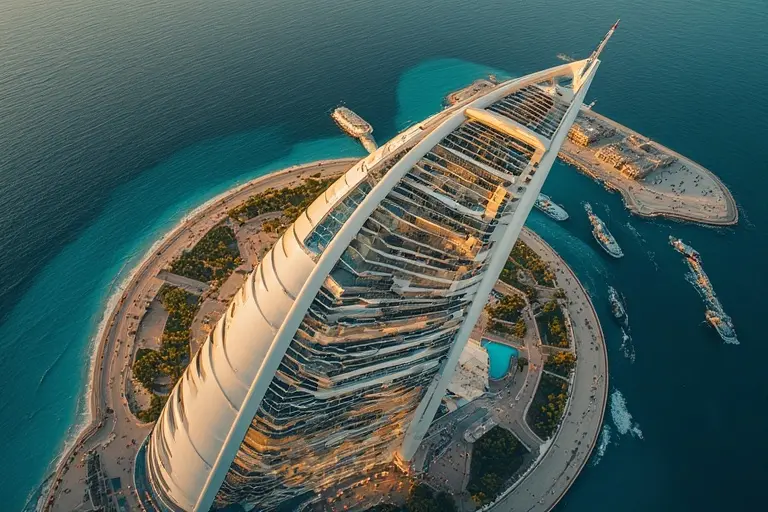
The location he chose was shocking. It wasn’t on the beach. It was 280 meters (920 feet) out in the ocean.
This was the first great challenge.
How to Build a Skyscraper in the Sea
Before the hotel could go up, the land had to be created.
Engineers had to build a private, artificial island. This wasn’t a simple pile of sand. They needed an island that could protect a 321-meter (1,053 ft) skyscraper from the powerful sea.
They built a “breakwater” of giant, specially designed concrete blocks. These blocks are porous, meaning they have holes. When a huge wave hits, the water goes into the block, and its power fades away. It’s an amazing piece of engineering you never even see.
To secure the building, they drilled 230 concrete piles deep into the sand, some going 45 meters down. The foundation is held in place by friction, like gripping a pole with your hands.
This island alone took three years to build. The hotel itself only took two.
The Sail: Architecture That Tells a Story
The design brief was simple: “It must be an icon.”
The architect, Tom Wright, delivered. He designed the building to look like the billowing sail of a dhow, a traditional Arab sailing boat. This was a perfect nod to Dubai’s maritime heritage.
But how do you make a building of glass and steel look like a soft sail?
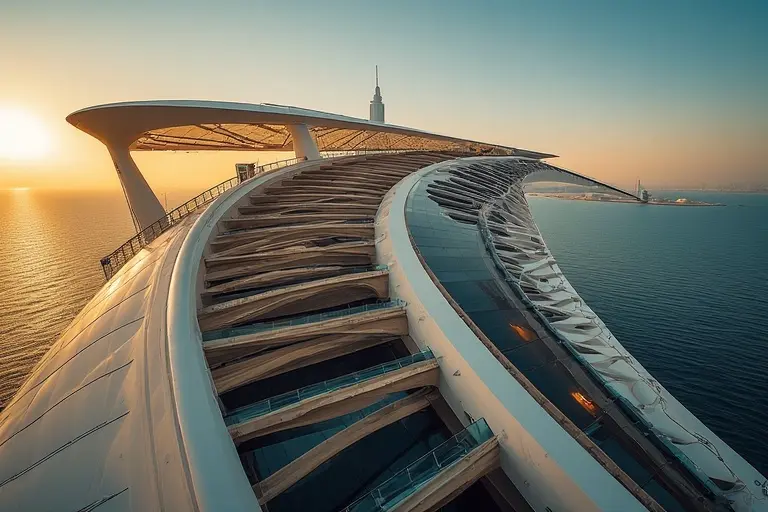
This is where the architecture gets truly clever. The building has a steel “exoskeleton.” These are the giant white trusses you see on the outside. This frame supports the entire building, like a ribcage.
The “sail” itself is made of a special Teflon-coated fiberglass. During the day, it glows a brilliant white. At night, it becomes a giant screen for light shows. It’s the first time this material was ever used this way on such a massive scale.
Inside the Icon: The “7-Star” Legend
So, where did the “7-star” name come from?
A British journalist visited before the hotel officially opened in 1999. She was so amazed by the luxury that she told her editor it must be a “7-star” hotel. The name stuck.
The hotel itself doesn’t use this term. They simply call it the “world’s most luxurious hotel.”
When you walk in, you are in the world’s tallest hotel atrium. It’s 180 meters (590 feet) high. The interior is designed to look like a treasure chest. It is filled with:
- 24-carat gold: Over 1,790 square meters of gold leaf are used.
- Statuario Marble: This is the same rare marble that Michelangelo used.
- A “water and fire” lobby: Dancing fountains and fire displays greet you.
Every guest gets a two-floor duplex suite with a private butler. This level of service is incredible. This gold standard has inspired luxury across the city. Many visitors, after seeing this, often explore exclusive real estate viewings on the nearby Palm Jumeirah.
More Than a Hotel: The Famous Helipad
The building’s story doesn’t end with its design. The helipad, hanging off the building 210 meters up, became an icon itself.
In 2005, Roger Federer and Andre Agassi played a friendly tennis match up there. It created one of the most famous photos in sports history.
Since then, it has hosted F1 cars, golf shots, and more. It’s a symbol of Dubai’s “anything is possible” attitude.
How to Experience the Burj Al Arab
You can’t just walk into the Burj Al Arab. It’s private and exclusive. But as a guide, I know the best ways to see it.
- Book a Tour: The hotel now offers a “Inside Burj Al Arab” tour. It’s a 90-minute butler-guided tour that shows you the Royal Suite and tells the hotel’s story.
- Make a Reservation: You can book afternoon tea at Sahn Eddar or dinner at one of the famous restaurants, like the underwater-themed Al Mahara.
- See it from the Water: This is my personal favorite. The view of the hotel from a private yacht charter at sunset is unbeatable. It truly shows you the “sail” in its element.
- Arrive in Style: You can arrive by helicopter. Or, you can book a table and arrive in a gleaming Rolls-Royce, part of Dubai’s amazing luxury car rental fleets.
The Story Today: Still an Icon?
Absolutely.
The Burj Al Arab was the building that started it all. It was a massive gamble that paid off, telling the world that Dubai was a place where dreams were built.
Today, even with taller buildings like the Burj Khalifa, the Burj Al Arab remains the heart of Dubai’s luxury story. It’s not just architecture; it’s a promise of what’s possible.
You can book your own night in this iconic building using our 2025 guide to suite prices and booking.
Frequently Asked Questions (FAQ)
- 1. Who designed the Burj Al Arab?
The main architect was Tom Wright of WKK Architects (formerly Atkins). He was given the brief to create an icon for Dubai, and he sketched the sail concept. - 2. Is the Burj Al Arab really a 7-star hotel?
Officially, no. The 1-to-5-star hotel rating system doesn’t go that high. The “7-star” nickname was created by a journalist who was amazed by its luxury. The hotel’s management prefers to call it the “world’s most luxurious hotel.” - 3. How was the Burj Al Arab built on the water?
It was built on a man-made island 280 meters from shore. This island was built first, using special “hollow” concrete blocks to break waves. The hotel’s foundation consists of 230 long concrete piles drilled deep into the sand. - 4. Can you visit the Burj Al Arab without staying there?
Yes. You cannot walk in for free, but you can get access by booking the official “Inside Burj Al Arab” tour or by making a dining reservation at one of its restaurants or lounges.
